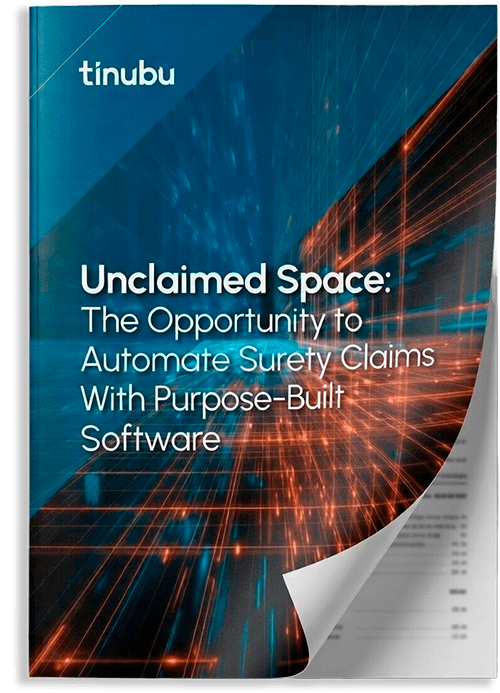
Tinubu is pleased to share a new article exploring why surety claims remain one of the most underserved areas in insurance technology, and how purpose built software can transform the way carriers handle their most complex and costly scenarios.
A High Stakes Process Running on Workarounds
The U.S. surety market is valued at over $10.5 billion in premiums, with industry claim costs running at roughly $2 billion per year. When including handling, legal, and related expenses, total claim related costs can reach $2.5 billion annually. Yet most carriers still manage these critical processes using generic Property & Casualty systems or aging, custom built tools that are costly to maintain and difficult to evolve.*
Why Surety Claims Are Uniquely Complex
Unlike typical insurance claims, surety claims involve a three party guarantee that fundamentally changes the nature of the process:
- Claims are long running and highly judgment driven, often taking years to resolve
- The surety must evaluate multiple resolution routes: deny, pay, finance, tender, complete, or settle
- Each route triggers different documentation, approvals, and downstream obligations
- Up to five or six parties may be involved, including subcontractors and project owners
- The process encompasses reserve management, vendor coordination, project oversight, and subrogation
Where Current Systems Fall Short
Carriers typically rely on one of two suboptimal paths, both of which create friction and risk:
- Generic P&C systems: Built for two party claims, these platforms lack fields for tracking indemnity agreements, do not support the pre claim investigation phase unique to surety, and struggle with multi party coordination
- Custom built tools: These quickly become legacy systems burdened by maintenance costs and feature creep, with critical tracking falling to spreadsheets and email
The result is a fragmented operating environment that limits visibility, increases operational risk, and compounds the chance of error.
What Purpose Built Claims Software Must Include
Based on extensive discovery with surety carriers and industry experts, a true surety first claims platform should deliver:
- Surety native processes and terminology built for the tripartite agreement structure
- Comprehensive information capture with a central repository for all claim related data
- Proactive risk management integrating underwriting data to flag at risk projects early
- End to end workflow support from notice of claim intake through subrogation
- Task automation freeing expert claims handlers from administrative burden
- Direct integration with underwriting and bond information
- Tools to structure and search large volumes of unstructured documents
- Dashboards and reporting providing real time visibility to all stakeholders
Read the Full Article
Get the complete analysis from surety industry experts on why claims technology must evolve and what carriers should look for in a purpose built solution.






Resource Center
Our customers are solving their specialty insurance challenges in interesting ways. Discover how Tinubu Surety for Carriers delivers powerful results and gain access to Tinubu’s unmatched industry expertise.

Surety
Shopping for the Right SaaS Platform for Your Surety Business

Surety
Tinubu Surety Solution for Brokers & Agents Product Sheet

Surety
