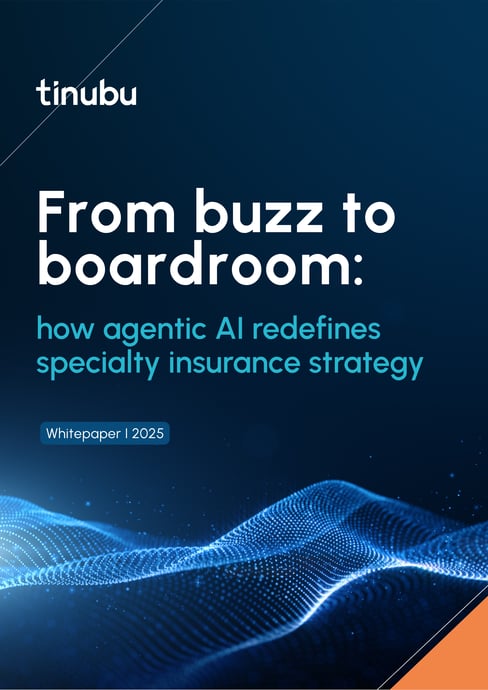
Tinubu has published a new whitepaper by its CTO, Yvan Saule: From Buzz to Boardroom: How Agentic AI Redefines Specialty Insurance Strategy.
Beyond chatbots: AI that acts
Generative AI has dominated headlines, but the real revolution for specialty insurers goes beyond chatbots that talk. Agentic AI refers to systems where multiple specialized agents can autonomously reason, plan, and execute tasks inside governed workflows, handing off to humans only when it matters. It represents a step-change in how insurers run their core operations, moving from efficiency gains at the margins to a fundamental transformation of operating models.
The timing is no coincidence. A recent Capgemini study estimated agentic AI could create up to $450 billion in economic value by 2028, and 20% of insurance organizations are already piloting AI agents.
Three domains where it delivers today
The whitepaper details how agentic AI is already producing measurable results across three core areas:
- Underwriting: automated submission triage has cut review times by up to 65%, freeing underwriters to focus on complex risks and pricing decisions. For A&H, Tinubu's Underwriting Workbench bundles intelligent intake, real-time broker connectivity, and dynamic risk analytics into one place
- Claims: AI-powered intake agents now read scanned invoices, extract key fields, check them against policy terms, and flag gaps, delivering 40 to 60% faster claim intake with higher first-time-right documentation
- Legacy modernization: autonomous systems analyst agents scan legacy configurations, code, and databases, then produce phased migration plans, compressing what used to take weeks of consultant work into days. AI-augmented modernization can cut project timelines by 40 to 50%
What comes next
The whitepaper also looks ahead to emerging applications: early warning agents that act as 24/7 risk sentinels monitoring portfolio exposures, contract intelligence agents that analyse policy wordings and flag anomalies, and embedded decisioning where AI is woven directly into transactions, enabling real-time policy issuance for simple risks.
Governance is the differentiator
A key argument of the whitepaper is that once everyone uses AI, the technology itself becomes a new risk surface. The insurers who win will be those who build industrialized governance into the same stack: explainability by default, human-in-the-loop thresholds for material decisions, red-team testing, and circuit-breakers for agent-to-agent flows. The paper includes two executive checklists to help leaders turn conviction into architecture.





Resource Center
Our customers are solving their specialty insurance challenges in interesting ways. Discover how Tinubu Surety for Carriers delivers powerful results and gain access to Tinubu’s unmatched industry expertise.

Surety
Shopping for the Right SaaS Platform for Your Surety Business

Surety
Tinubu Surety Solution for Brokers & Agents Product Sheet

Surety
