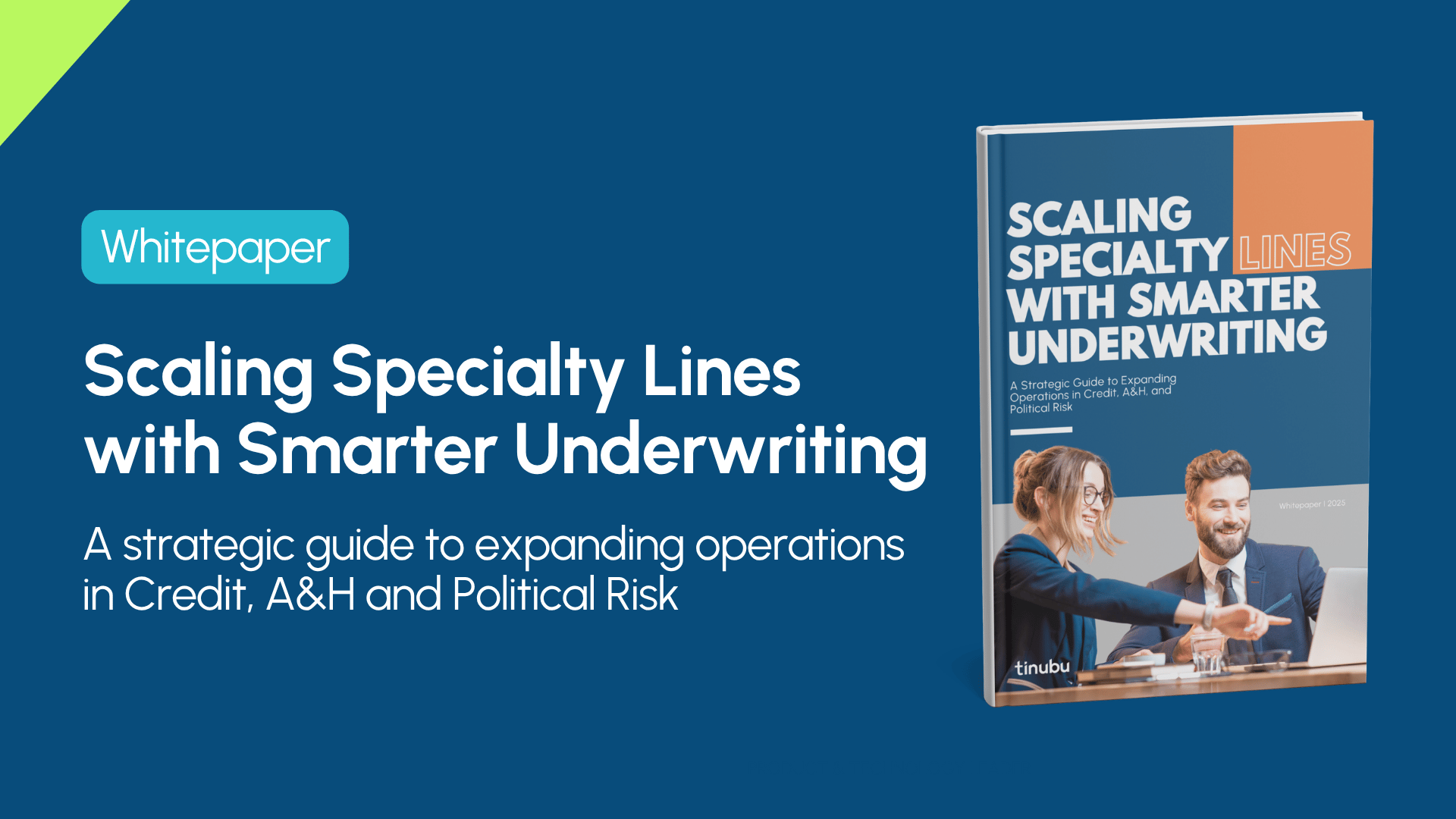
Tinubu is pleased to share a whitepaper by Paul Sicsic, VP Product, exploring why AI in specialty claims is fundamentally a judgment problem, not a technology problem, and how agentic AI can deliver speed, consistency, and foresight without sacrificing control.
Why Specialty Claims Are Different
Traditional automation transformed personal lines because those domains offer high volume, repeatable patterns, and structured data. Specialty lines are the opposite: low frequency, high complexity events where every claim presents unique facts and judgment calls. The pressure is visible across all specialty lines, from trade credit and cyber to marine, financial lines, energy, construction, and surety.
The Scale of the Challenge
The operational burden on specialty claims teams is significant:
- Adjusters spend up to 40% of their time on administrative tasks rather than adjudication
- Claims leakage can reach 30 to 50% due to inconsistency across teams and regions
- The industry loses 20% of claims staff annually, draining institutional memory
- Traditional machine learning requires structured data and repeatable patterns, which specialty claims offer neither
Three Strategic Choices Insurers Can No Longer Avoid
The whitepaper identifies three imperatives for specialty insurers looking to modernize claims:
- Deliver speed without sacrificing judgment: Agentic AI streamlines intake, evidence triage, and data extraction, reducing processing time by 50 to 80% while keeping human adjusters in control of decisions
- Ensure consistency without losing flexibility: A consistent framework enforced by AI agents ensures documentation completeness and compliance checks are always applied, while adapting to the uniqueness of each claim
- Embed foresight and proactive risk management: AI agents can surface early warning signals such as deteriorating credit, supply chain stress, or emerging systemic exposures, shifting claims from reactive adjudication to proactive portfolio protection
A Five Stage Operating Model
The whitepaper outlines a purpose built operating model for agentic claims:
- Intelligent intake: AI agents ingest first notice of loss from any channel, extract facts, and flag compliance red flags
- Adaptive routing: Claims are scored for complexity and directed to the right adjuster or workflow in real time
- AI augmented assessment: Coverage analysis, gap flagging, and recommended next steps with full uncertainty surfacing
- Evidence gathering: Automated document classification, conflict reconciliation, and missing item tracking
- Compliance and governance: Audit trail generation, explainable decisions, human override controls, and regulatory checks
Scaling AI Without Losing Trust
The whitepaper makes clear that governance is not optional. AI must operate within explicit boundaries, produce explainable recommendations, and automatically fall back to human adjusters when judgment or compliance demands it. Only 7% of insurers have scaled AI beyond pilots, and the paper provides a realistic trajectory: intake automation within 6 months, coverage analysis by 12 months, predictive reserving by 24 months.
Download the Whitepaper
Get the full executive paper on how agentic AI is reshaping specialty claims operations across trade credit, cyber, marine, financial lines, energy, construction, and surety.
.png?width=632&height=1008&name=Untitled%20design%20(1).png)





Resource Center
Our customers are solving their specialty insurance challenges in interesting ways. Discover how Tinubu Surety for Carriers delivers powerful results and gain access to Tinubu’s unmatched industry expertise.

Surety
Shopping for the Right SaaS Platform for Your Surety Business

Surety
Tinubu Surety Solution for Brokers & Agents Product Sheet

Surety
