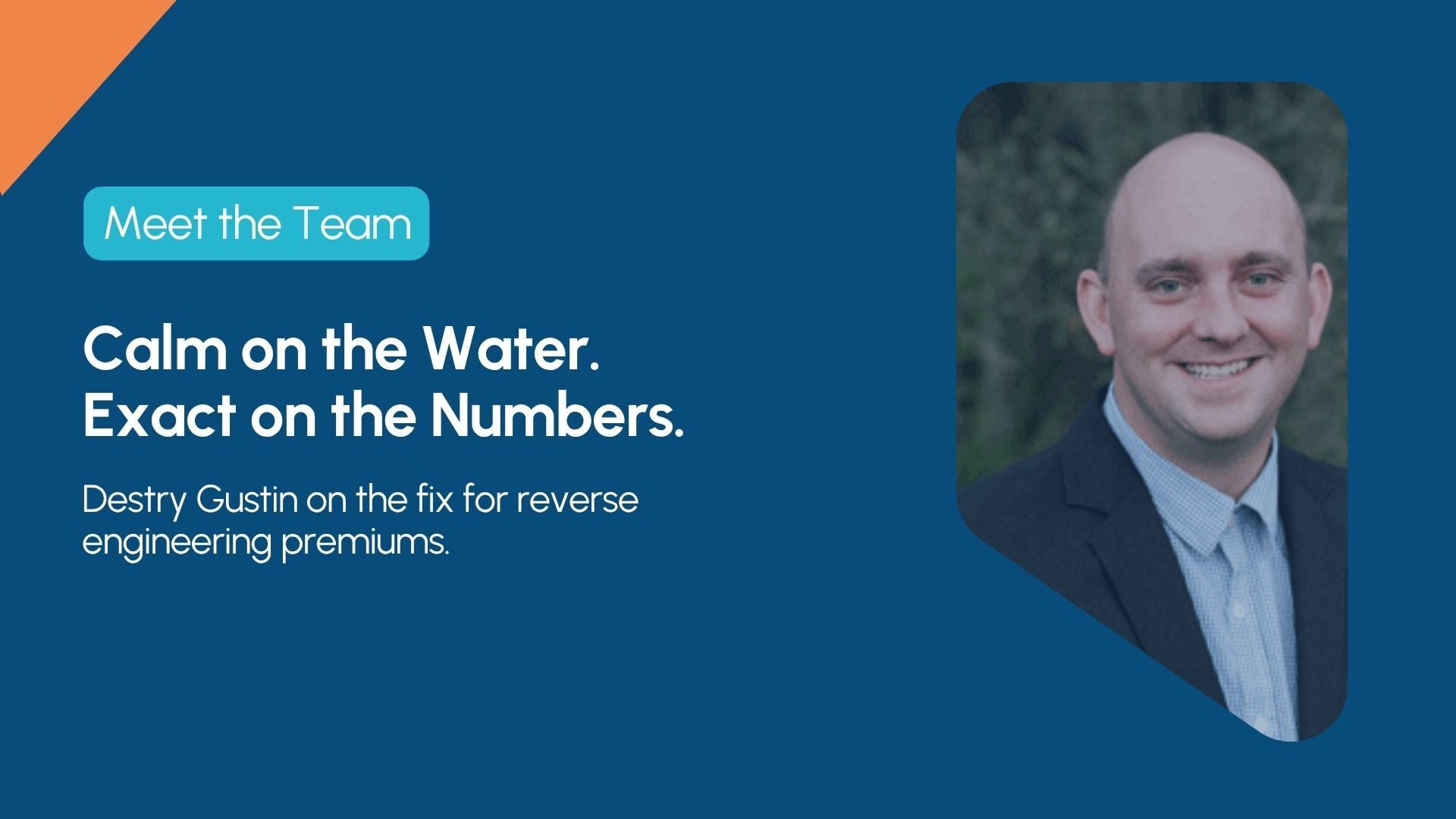
Destry Gustin spends his weekends fishing off the east coast of Florida, running his boat miles offshore. Those days involve “driving around aimlessly at six to eight miles per hour, hoping fish come and bite.” It’s a pretty relaxed relationship with uncertainty for someone whose day job involves making sure a number comes out exactly right, every single time.
As a Senior Product Manager for Tinubu’s carrier platform, Destry recently led the product side of a full rebuild of the Rating Engine, the system that calculates what a Surety bond actually costs, and provides full transparency into why. The rebuild was a major undertaking, and a chance to translate a highly technical rewrite into something carriers can truly feel the benefit of.
What’s your day-to-day like at Tinubu?
Destry: I work with our customers to understand their business needs and how our platform can best meet them, along with the improvements we can make to help customers achieve their goals. A lot of my job is translating what carriers tell us about their workflows, their pain points, and their compliance requirements into things our engineering team can build or refine.
What’s your background?
Destry: I started as a software developer at an insurance company, and eventually moved over to product, which I like a lot better. It’s fun working directly with customers and seeing a different side of solving problems than you get on the traditional engineering side. I like the challenge of creating a good but simple experience for customers, rather than making the math come out right on the back end. This is my first job in Surety, but the core discipline — understanding customer needs and building the right features around them — translates pretty directly.
Tell me about the Rating Engine. Why did it need a rebuild?
Destry: A lot of carriers still price bonds by hand, even with software in place. When an agent calls asking how a bond was priced, or why their commission was calculated a certain way, the answer often starts with someone opening a spreadsheet and reverse-engineering the math.
We rebuilt the Rating Engine so carriers don’t have to do that anymore. Now they get real-time calculation and full visibility into how every premium is derived. When agents ask about premiums and commissions, they and the carrier can see exactly what went into a premium and how it changed between transactions, which cuts down the back-and-forth.
We also wanted to improve the way the rating engine works for contract bonds. For bigger, more complex accounts, underwriters can now adjust rates with real precision, down to individual pricing components, instead of overriding a whole bond and losing track of what the original numbers were. There’s also a lot more flexibility for complex contract business, all on an architecture built to scale.
Getting pricing right consistently, across bond types and territories, takes real accumulated expertise: legislative requirements, tax structures, reporting rules that vary by jurisdiction. Tinubu has been building that knowledge for over 20 years, and we made sure it was fully embedded in the new engine rather than patched onto the old one.
How has the response been from carriers using it so far?
Destry: Really positive. We have two big customers testing it right now. One is a large, well-established multi-line carrier, and they’re delighted with the new capabilities. The other has a big contract bond portfolio, and their early feedback has also been very good, especially on the contract bond side.
If I had to explain it in one line: it makes it so people don’t have to think about what the premium should be, because the system calculates it right, every time. That sounds simple, but it’s genuinely hard to get right.
What else are you excited about right now?
Destry: Getting the Rating Engine rolled out to the rest of our customers is a big one. I’m also digging into our new UI project. We’re rebuilding the user experience for the whole platform. We’re simplifying it, making it easier to process bonds and get quotes out, and making the system faster and easier to use all around.
What do you do when you’re not working?
Destry: I enjoy pretty much anything on the water, so I go fishing a lot. I live on the east coast of Florida and mostly do offshore fishing, so I travel pretty far out. I’m after bigger pelagic fish like king fish and wahoo when I can get them: that means driving around slowly for hours, trying to find them. Sometimes I go for grouper and snapper instead; they’re easier to locate. They’re bottom feeders, so you can go to the reefs where they’re likely to be.
So you must eat a lot of fish…
I don’t eat that much of what I catch, if I’m honest — my neighbors do. I give them a lot of the fish, and they help me fix the boat in return. It all works out pretty well.