For carriers underwriting contract bonds, every submission is a small project of its own. A contractor wins a government project and needs a bond. The agency collects the documents (financial statements, work-in-progress schedules, supporting materials) via emails and phone calls, then forwards them to the carrier. Someone uploads the material into a document management system. The underwriter reviews the package, organizes it, runs external research, and only then starts the actual underwriting work.
“If you add up all these things, it is a very fragmented process,” says Rahul Guha, Tinubu’s Chief Technology Officer. The time from first submission to a workable underwriting package is “a minimum of two weeks, and often much more than that.”
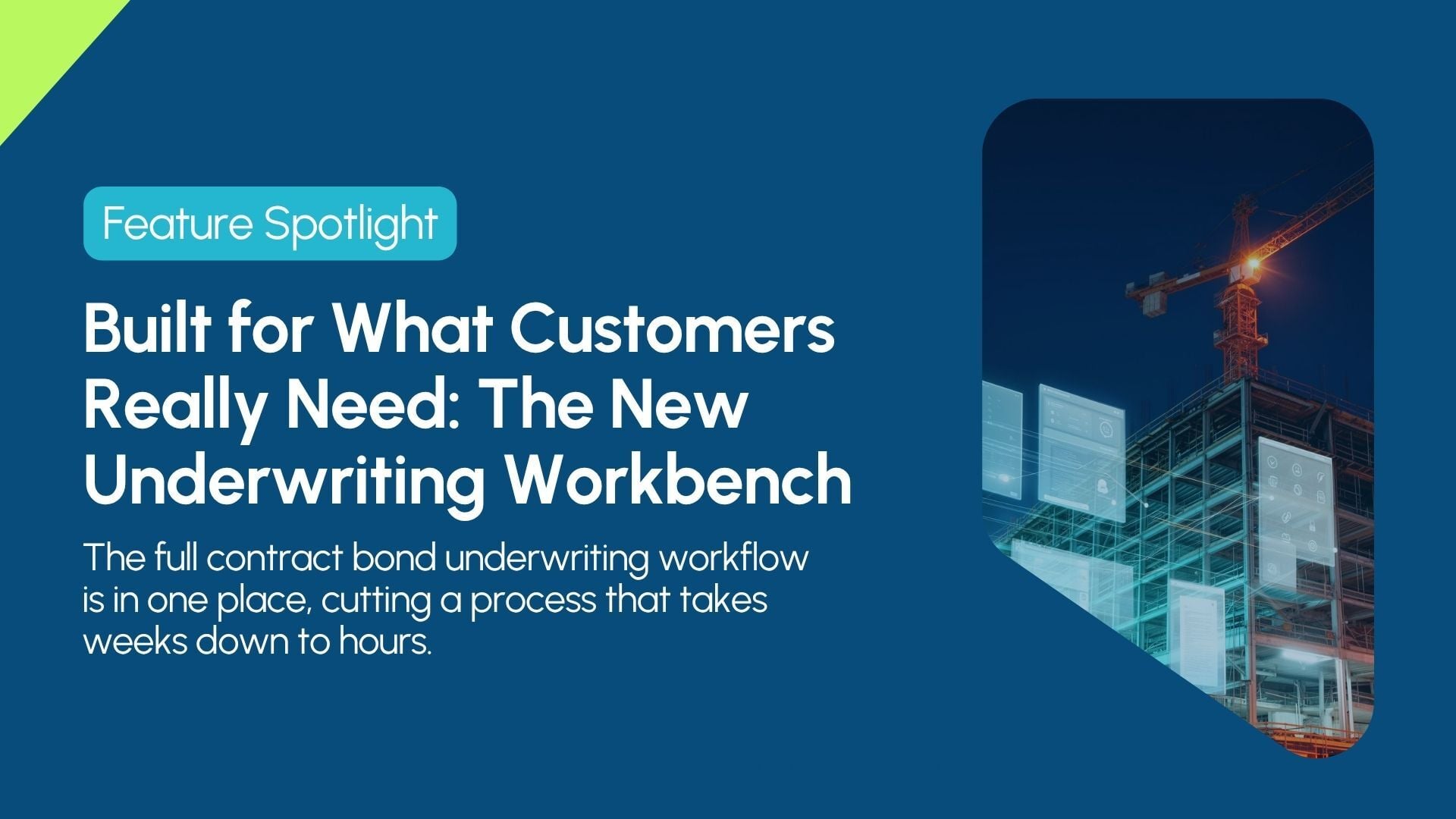
The Tinubu Underwriter Workbench is built to change that. It brings the full intake and analysis workflow into one place — not as a cosmetic layer over existing processes, but as a ground-up re-engineering of how underwriting data gets acquired, verified, and used. It also cuts the time this process takes from several weeks to two hours.
Built Around What Customers Really Asked For
Tinubu’s initial vision for the product leaned toward the analytical end of underwriting: risk assessment, weighted scoring, financial ratio modeling. Then the team talked to carriers.
“We initially started with one thing in mind,” Guha explains, “but customers made it clear they weren’t struggling with their analytical tools. They were struggling to get the data assembled in the first place. Carriers underwrite in different ways, but the administrative burden of acquiring, organizing, and verifying documents is common to all.”
High Speed Data Extraction
The first release covers the full intake and analysis workflow for a contract bond submission.
Principals upload required materials directly into the system. From there, AI handles document verification and data extraction. “I upload something,” Guha explains, “and at that point I have no way to know whether it’s a financial statement or an electric bill. And if it is a financial statement, it might be Microsoft’s financial statement, not mine.” The Workbench uses AI to classify each document, verify it belongs to the correct principal, and extract the relevant fields. “A significant part of this,” Guha notes, “is actually AI-native.”
Once data is extracted, the Workbench builds the financial picture automatically. Before, an underwriter had to locate the source documents, open a spreadsheet, and run the numbers by hand. The process consumed time and introduced errors at exactly the point where accuracy matters most. Now, balance sheets, income statements, and the key ratios underwriters rely on — liquidity, leverage, working capital — are calculated and surfaced without manual input.
Automated Analysis
Work-in-progress analysis is one of the most costly parts of manual data assembly. One of the strongest risk signals in contract Surety is margin fade: the incremental erosion of a contractor’s gross profit across consecutive reporting periods. Historically, catching it means hunting through archive folders and building comparison files by hand. The Workbench automates that analysis, generating trending comparisons across multiple WIP periods and flagging anomalies automatically, so the signal surfaces without the manual work.
Geographic exposure is another risk dimension that has required manual cross-referencing. An underwriter who wants to know whether a contractor has overextended their field operations — or whether a carrier’s total exposure is heavily concentrated in a single region — has typically had to piece together that picture from addresses on documents. Active project locations are now plotted on a map automatically, making aggregate geographic risk visible at a glance rather than something to be assembled from spreadsheets.
External Research
Beyond what the principal uploads, underwriters have always needed information that isn’t in the submission package.
“For example, they will go to a particular government website, find out for that particular contractor what other contracts they are working on,” Guha says. That external research now happens automatically.
The combined effect: “It will be straight through. Underwriters will upload the data or the files, it will be extracted, and everything will be in a place for them to look at within a couple of hours.”
Part of a Bigger Shift for Surety
The Underwriter Workbench is one of several investments Tinubu is making to modernize Surety end-to-end. It serves carriers underwriting both commercial and contract bonds, with specialized capabilities for contract bond complexities : WIP analysis, margin fade detection, and geographic exposure mapping. Across the platform, the goal is the same: replace the assembly work that has consumed underwriters' days, so the people doing the underwriting can spend their time on the work that actually requires their judgment.